Wie trouwde met Catharina II van Rusland?
Grigori Potjomkin huwde Catharina II van Rusland . Het leeftijdsverschil was 10 jaar, 4 maanden en 22 dagen.
Peter III van Rusland huwde Catharina II van Rusland op . Catharina II van Rusland was 16 jaar oud op de trouwdag (16 jaar, 3 maanden en 30 dagen). Peter III van Rusland was 17 jaar oud op de trouwdag (17 jaar, 6 maanden en 11 dagen). Het leeftijdsverschil was 1 jaar, 2 maanden en 11 dagen.
Catharina II van Rusland: Huwelijksstatus Tijdlijn
1 Pixel = 1 Month

Catharina II van Rusland
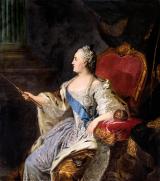
Catharina II Aleksejevna (Russisch: Екатерина II Алексеевна, Jekaterina II Aleksejevna; Stettin, 2 mei 1729 – Tsarskoje Selo, 17 november 1796), bijgenaamd Catharina de Grote (Russisch: Екатерина Великая, Jekaterina Velikaja), was van 1762 tot 1796 tsarina van Rusland.
Ze werd in het Duitse Stettin in Pommeren (sinds 1945 Szczecin in Polen) geboren als Sophia Augusta Frederika, prinses van Anhalt-Zerbst-Dornburg, dochter van vorst Christiaan August van Anhalt-Zerbst en hertogin Johanna Elisabeth van Sleeswijk-Holstein-Gottorp. Ze was een nicht van de koningen Gustaaf III en Karel XIII van Zweden en echtgenote van de Russische troonopvolger Peter III.
Lees meer...
Grigori Potjomkin
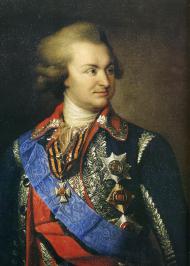
Prince Grigory Aleksandrovich Potemkin-Tauricheski (11 October [O.S. 30 September] 1739 – 16 October [O.S. 5 October] 1791) was a Russian military leader, statesman, nobleman, and favourite of Catherine the Great. He died during negotiations over the Treaty of Iași, which ended a war with the Ottoman Empire that he had overseen.
Potemkin was born into a family of middle-income landowners of Russian nobility. He first attracted Catherine's favor for helping in her 1762 coup, then distinguished himself as a military commander in the Russo-Turkish War (1768–1774). He became Catherine's lover, favorite and possibly her consort. After their passion cooled, he remained her lifelong friend and favored statesman. Catherine obtained for him the title of Prince of the Holy Roman Empire and gave him the title of Prince of the Russian Empire among many others: he was both a Grand Admiral and the head of all of Russia's land and irregular forces. Potemkin's achievements include the peaceful annexation of the Crimea (1783) and the successful second Russo-Turkish War (1787–1792), during which the armed forces under his command besieged Ochakov.
In 1775, Potemkin became the governor-general of Russia's new southern provinces. An absolute ruler, he worked to colonize the wild steppes, controversially dealing firmly with the Cossacks who lived there. He founded the towns of Kherson, Nikolayev, Sevastopol, and Yekaterinoslav. Ports in the region became bases for his new Black Sea Fleet.
His rule in the south is associated with the (probably mythical) "Potemkin village", a ruse involving the construction of painted façades to mimic real villages, full of happy, well-fed people, for visiting officials to see. Potemkin was known for his love of women, gambling and material wealth. He oversaw the construction of many historically significant buildings, including the Tauride Palace in Saint Petersburg.
Lees meer...Catharina II van Rusland
Peter III van Rusland

Peter III Fyodorovich (Russian: Пётр III Фёдорович, romanized: Pyotr III Fyodorovich; 21 February [O.S. 10 February] 1728 – 17 July [O.S. 6 July] 1762) was Emperor of Russia from 5 January 1762 until 9 July of the same year, when he was overthrown by his wife, Catherine II (the Great). He was born in the German city of Kiel as Charles Peter Ulrich of Schleswig-Holstein-Gottorp (German: Karl Peter Ulrich von Schleswig-Holstein-Gottorp), the grandson of Peter the Great and great-grandson of Charles XI of Sweden.
After a 186-day reign, Peter III was overthrown in a palace coup d'état orchestrated by his wife, and soon died under unclear circumstances. The official cause proposed by Catherine's new government was that he died due to hemorrhoids. This explanation was met with skepticism, both in Russia and abroad, with notable critics such as Voltaire and d'Alembert expressing doubt about the plausibility of death from such a condition.
The personality and activities of Peter III were long disregarded by historians and his figure was seen as purely negative, but since the 1990s, after the dissolution of the Soviet Union, more attention has been directed at the decrees he signed. His most notable reforms were the abolition of the secret police, exemption of nobles from compulsory military service, confiscation of church lands, and equalisation of all religions. He also put an end to the persecution of the Old Believers and made the killing of serfs by landowners punishable by exile. Although he is mostly criticised for undoing Russian gains in the Seven Years' War by forming an alliance with Prussia, Catherine continued it and many of his other policies.
After Peter III's death, many impostors thrived, pretending to be him, the most famous of whom were Yemelyan Pugachev and the "Montenegerin Tsar Peter III" (Stephan the Little).
Lees meer...