Wie trouwde met Alice Chaucer, Duchess of Suffolk?
John Phelip huwde Alice Chaucer, Duchess of Suffolk .
Thomas Montacute, 4th Earl of Salisbury huwde Alice Chaucer, Duchess of Suffolk .
Het huwelijk eindigde .
William de la Pole, 1st Duke of Suffolk huwde Alice Chaucer, Duchess of Suffolk op . William de la Pole, 1st Duke of Suffolk was 34 jaar oud op de trouwdag (34 jaar, 0 maanden en 18 dagen).
Alice Chaucer, Duchess of Suffolk: Huwelijksstatus Tijdlijn
1 Pixel = 1 Month

Alice Chaucer, Duchess of Suffolk
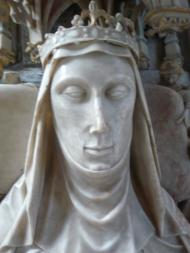
Alice Chaucer, Duchess of Suffolk (c. 1404–1475) was a granddaughter of the English poet Geoffrey Chaucer. Married three times, she eventually became a Lady of the Most Noble Order of the Garter, an honour granted rarely to women and marking the friendship between herself and her third husband, William de la Pole, 1st Duke of Suffolk, with King Henry VI and his wife Margaret of Anjou.
Lees meer...
John Phelip
Sir John Phelip (died 2 October 1415) was an English knight who served as knight of the shire (MP) for Worcestershire.
Lees meer...Alice Chaucer, Duchess of Suffolk
Thomas Montacute, 4th Earl of Salisbury
Thomas Montagu, 4th Earl of Salisbury, KG (13 June 1388 – 3 November 1428) of Bisham in Berkshire, was an English nobleman and one of the most important English commanders during the Hundred Years' War.
Lees meer...Alice Chaucer, Duchess of Suffolk
William de la Pole, 1st Duke of Suffolk
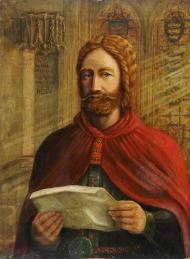
William de la Pole, 1st Duke of Suffolk (16 October 1396 – 2 May 1450), nicknamed Jackanapes, was an English magnate, statesman and military commander during the Hundred Years' War. He became a favourite of Henry VI of England, and consequently a leading figure in the English government where he became associated with many of the royal government's failures of the time, particularly on the war in France. Suffolk also appears prominently in Shakespeare's Henry VI, parts 1 and 2.
He fought in the Hundred Years' War and participated in campaigns of Henry V, and then continued to serve in France for King Henry VI. He was one of the English commanders at the failed Siege of Orléans. He favoured a diplomatic rather than military solution to the deteriorating situation in France, a stance which would later resonate well with King Henry VI.
Suffolk became a dominant figure in the government, and was at the forefront of the main policies conducted during the period. He played a central role in organizing the Treaty of Tours (1444), and arranged the king's marriage to Margaret of Anjou. At the end of Suffolk's political career, he was accused of maladministration by many and forced into exile. At sea on his way out, he was caught by an angry mob, subjected to a mock trial, and beheaded.
His estates were forfeited to the Crown but later restored to his only son, John. His political successor was the Duke of Somerset.
Lees meer...